
Find Who Owns Thomas County Land
Matching two records gives the clearest answer. Thomas County QPublic ties an address to the tax digest, listing the owner of record, parcel number, mailing address, and legal description. The GSCCCA Real Estate Search then shows the deed indexed under both buyer and seller. Start with the parcel card. Confirm with the newest deed.
- Enter the situs address in QPublic. Try the number and street without extra punctuation if the first query fails.
- Copy the displayed owner name, parcel number, legal description, and any deed book or sale reference.
- Search the newest grantee deed in GSCCCA. Match its legal description or book and page to the same parcel.
- For an LLC, trust, or estate, keep the exact indexed name and check the proper entity or probate record.
Timing explains most conflicts between the two screens. A deed can reach the clerk before the next digest is published. So compare dates instead of assuming either record is wrong. The latest valid recorded transfer is the key evidence. A title professional must resolve any legal doubt, though. The official QPublic landing page shows the county's assessment-search entry.
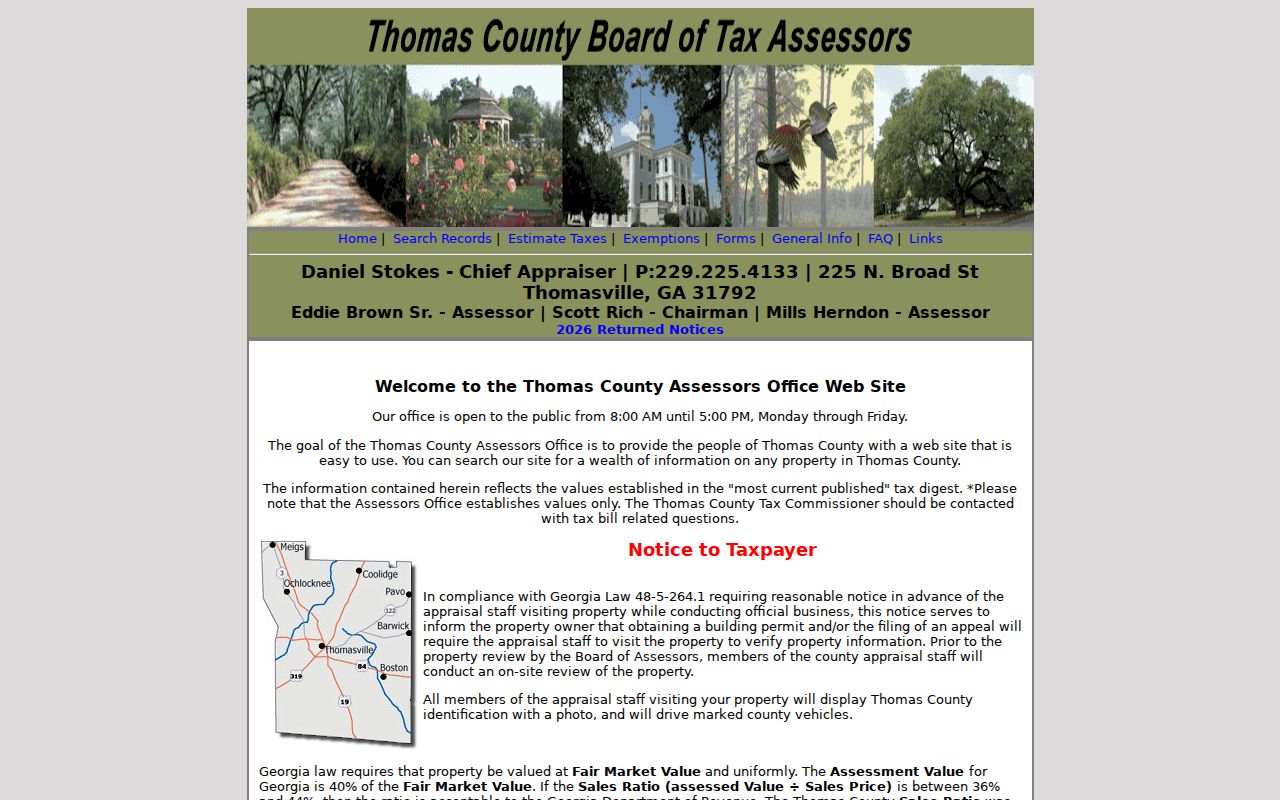
Use the assessment result to pin down the parcel first. Only then confirm the grantee in the deed index.
Thomas County QPublic Owner Fields
Thomas County advertises searches by owner name, location address, parcel number, legal information, and subdivision. That mix matters when land has no clean postal address. A rural tract may surface faster by parcel number or legal wording. Several lots can also share one mailing address. The subdivision field helps split them apart.
| Search clue | Best use | Check in result |
|---|---|---|
| Location address | House or storefront | Owner, parcel ID, situs |
| Owner name | Person or entity holdings | Name form and mailing address |
| Parcel number | Exact cross-reference | Legal description and map |
| Legal or subdivision | Vacant land and lots | Lot, block, acreage |
Parcel IDs in Thomas County can include spaces, letters, and suffixes. Preserve that exact format. It is the most reliable join key between the assessment roll, GIS, tax file, and appeal papers.
Thomas County Owner Versus Occupant
The owner field answers a land-record question. It does not identify every resident. A situs address marks where the parcel sits, while a mailing address tells the county where tax correspondence goes. The two addresses often differ for a rental, family trust, estate, company, farm, or an owner who lives elsewhere.
- Owner of record
- The name carried on the current public roll or vesting deed.
- Vesting
- The way title is stated in the deed, including joint or entity ownership.
- Grantee
- The person or entity receiving an interest in a recorded deed.
- Situs address
- The location assigned to the parcel, not proof of residence.
Never swap in an occupant, lender, or tax-mail recipient as the owner. A security deed can name a lender, but it does not make that lender the fee owner.
Note: QPublic reflects the most current published digest, so a newly recorded transfer may appear first in the deed index.
Confirm Thomas County Property Ownership
The Thomas County Clerk of Superior, State, and Juvenile Courts keeps county land records and links users to GSCCCA. Search the assessor name as a grantee first. Then inspect the latest conveyance. Write down the instrument type, recording date, book and page or instrument number, grantor, grantee, and legal description. A street address alone is a weak match because older deeds may omit it. Warranty and quitclaim deeds can convey title. Executor or administrator deeds may follow probate. A cancellation releases a prior security interest. A plat maps lots and easements, and each document type plays a different role. The newest filing is not always a conveyance, so read its type before deciding who owns the property.
Thomas County LLC and Estate Owners
QPublic may show an LLC, trust, estate, government body, or other entity in place of a person's name. Search that exact spelling in the deed index. For a Georgia company, the Secretary of State Business Search covers business-name, control-number, registered-agent, officer, and designated-agent fields. The filing explains the entity. But it does not replace the deed. If the named owner has died, the Thomas County Probate Court may hold a will, petition to sell, order, or letters naming the person authorized to act. The recorded executor or administrator deed completes the land-record trail. An estate file with no later deed can signal that more digging is needed.
Older Thomas County Ownership Clues
The Thomas County deed trail reaches well past modern screens. The FamilySearch catalog lists county deeds from 1826 through 1911. It also holds general grantor and grantee indexes from 1826 through 1910. These books may be browsable rather than searchable by name. Start from a known book and page, then work backward through each seller's earlier purchase. Historic maps, plats, tax rolls, directories, and local collections can explain a changed address. They can also clarify an old subdivision name. Treat them as clues, not title proof. The recorded deed sequence remains the ownership spine. When the web index ends, the clerk's counter or archive route is the fallback.
Where Thomas County Owner Records Live
Each official source answers a different part of the question. Moving among them beats trusting one name field.
| Source | Owner Info It Gives | Access |
|---|---|---|
| QPublic assessment roll | Published owner and mailing fields | Public online search |
| Clerk and GSCCCA | Grantee on the recorded transfer | Online index and clerk copies |
| Secretary of State | Georgia entity filing details | Public business search |
| CMAP parcel viewer | Parcel location and map context | Public viewer |
The assessor is the fastest route to a name. The clerk is the transfer check. GIS confirms the parcel sits where you expect. For a present-name question alone, that short chain usually suffices. For a legal transaction, get the actual deed and a professional title review.
Ask Thomas County for Offline Records
Georgia's Open Records Act covers Thomas County records that never reach a portal. Write a tight request. Name the parcel, the record type, the date range, and the format you want. Agencies generally must respond within three business days. Or they send a written explanation of timing, cost, or any exemption claimed. Search and redaction labor becomes billable after the first fifteen minutes. A narrow request beats a fishing expedition into every paper tied to a common surname.
Thomas County Filing Alerts
One free watch tool stands out. The clerk links to the Filing Activity Notification System, and FANS can flag a chosen name in a later real-estate or personal-property filing. It looks forward only. It cannot certify ownership, block a filing, or substitute for reading the deed image itself.
Strange mail about a deed copy or a title problem deserves a second look. Check it against the clerk's official site and phone number. Keep the parcel ID, book and page, and recording date close by. Staff can use those details to separate a genuine filing from a sales pitch.
When Thomas County Addresses Fail
Addresses fail for familiar reasons. They may be old, abbreviated, or rural. Others are newly assigned, or simply different from the tax mailing address. Strip extra punctuation and try the street name without its type. Searching by legal information or subdivision works too. County GIS maintains the 911 address database. QPublic ties the situs to a parcel, and the two systems do not always update in step.
When a likely parcel surfaces, compare its location, acreage, legal description, and nearby roads. Record the APN exactly as shown, spaces, letters, suffix and all. That identifier becomes the bridge to deed records. Resist forcing a match just because a surname looks familiar.
Vacant land may carry no house number at all. A plat name, lot and block, land lot, or an adjacent parcel can serve as the key instead. Historic directories sometimes explain renumbering. The legal description must still confirm the land. If online routes dead-end, bring the facts you have to the Thomas County Assessor or Clerk.
Limits of Thomas County Owner Searches
A public name proves little on its own. It does not show that the person occupies the land. It does not prove sole title or the right to convey it. Unrecorded claims, indexing lag, probate, court orders, easements, and name changes all complicate the picture. Georgia law also shields certain personal data and qualifying confidential addresses. A VoteSafe or similar protected-address program can leave an official record. That record may show a substitute mailing arrangement.
Lawful use. Thomas County owner information supports property diligence and civic research. Never use it to harass, threaten, or target anyone.
Stakes change the rules. When money, litigation, or a transfer rides on the result, ask the clerk for the recorded copy and bring in a Georgia title professional. A database result is an index, never a title opinion.
Note: Keep each official citation with its search date so later ownership changes stay recognizable.
Careful Thomas County ownership work preserves the owner spelling and the parcel number. It also keeps the legal description, instrument type, recording date, and book or page reference. Those fields let another reader rebuild the answer from official sources. When a business, trust, estate, or joint ownership appears, quote the public vesting name as written. Do not translate it into an individual. If records conflict, state which one is newer and what remains unresolved. Clear limits belong in any accurate property owner search.