
What Thomas County Deed Records Show
The Clerk of Superior Court holds Thomas County's official land records. Deeds, liens, and plats route through GSCCCA. A recorded deed names the parties, cites recording references, and describes the land, while related instruments each carry their own meaning and must be read separately.
| Deed Type | What It Does | Common Use |
|---|---|---|
| Warranty deed | Conveys land with stated title covenants. | Ordinary sale. |
| Limited warranty deed | Limits the grantor's promises. | Negotiated transfer. |
| Quitclaim deed | Conveys whatever interest the grantor holds. | Corrective or family work. |
| Executor deed | Transfers estate property under authority. | Probate sale. |
| Deed under power | Records transfer after a security-deed power is exercised. | Foreclosure trail. |
A Georgia security deed secures debt. It is not the vesting deed. Assignments and cancellations track the security interest over time, while easements, plats, lis pendens, executions, and liens can burden the property without ever naming a new fee owner.
GSCCCA Routes Into Thomas County Deeds
The GSCCCA Real Estate Search supports statewide, regional, and single-county searching. Direct and reverse party indexes, book/page, instrument type, sales price, plat name, deed images, and lien searching all appear in its official description. Regular access runs $14.95 monthly. Premium runs $29.95 monthly from July 1, 2025. Premium adds address search. GSCCCA publishes no start year for the first online Thomas County deed image.
| Route | Key | Purpose |
|---|---|---|
| Direct | Grantor | Find transfers made by a party. |
| Reverse | Grantee | Find acquisitions by a party. |
| Book/page | Citation | Retrieve one known record. |
| Instrument type | Deed, lien, plat | Separate unlike filings. |
Thomas County's Deed Books Begin in 1826
Thomas County's deed books open in 1826. The FamilySearch Thomas County catalog documents 83 reels: deeds from 1826 through 1911, mortgages from 1855 through 1911, and general grantor and grantee indexes from 1826 through 1910. Images are often browsable rather than searchable. Pull a book and page from the index first, then open the deed volume itself.
This source supplies a documented route beyond an uncertain online imaging cutoff.
The Thomas County Grantor-Grantee Index
Rebuild a chain by matching land, not surnames.
- Find the current acquisition with the owner indexed as grantee.
- Copy its grantor, dates, citation, and legal description.
- Search that grantor as an earlier grantee and confirm the same tract.
- Repeat, then use the 1826–1910 index and books when online coverage ends.
- Grantor
- The party transferring an interest.
- Grantee
- The party receiving an interest.
- Chain of title
- The linked conveyances for the same land.
- Book/page or instrument number
- The retrieval citation assigned to a recording.
Thomas County Deed and Lien Indexes
Trace security deeds, assignments, and cancellations in order. Then check materialman's liens, lis pendens, general executions, federal tax liens, hospital liens, and UCC real-estate notices. Easements and restrictions matter too. Many recordings and cancellations run $25. A gap online proves little, because indexing delay, name variation, instrument classification, or an unrecorded interest can all hide a filing.
Thomas County Deed Dates and Descriptions
A deed usually shows an execution date. The recording date comes later. Arrange the chain by the instruments themselves and their relationships rather than by assuming those dates match. Copy every book/page or instrument number, the county, party role, deed type, consideration field when present, and the legal description in full. Index entries hide behind spelling variants and initials. For an LLC, compare the exact vesting name with the Georgia Secretary of State Business Search, remembering that the corporate record does not establish title.
The legal description is the strongest continuity check. Addresses can mislead. A situs address may be reassigned, and a mailing address may belong to an out-of-county owner, an estate representative, or a tax recipient. A subdivision lot should track back to its plat name and lot/block notation. Rural tracts instead follow acreage, roads, streams, monuments, survey calls, and adjoining owners. If the description changes, determine whether the record documents a split, combination, correction, reservation, or only a drafting variation.
A death breaks the chain differently. Search Thomas County Probate Court for the will, the executor or administrator appointment, any petition or order to sell, and related estate papers. TrueFiling began January 1, 2026, under a digitization initiative. The court publishes no public estate-name search. Ask the clerk directly. Call 229-225-4116 or visit the Probate Court at 325 N. Madison Street during weekday hours, then connect any order to the recorded executor or administrator deed.
FANS Watches New Filings Only
The Filing Activity Notification System is free. It alerts registrants to later matching real-estate filings. The service watches only new filings, is forward-looking, and is not guaranteed complete or current.
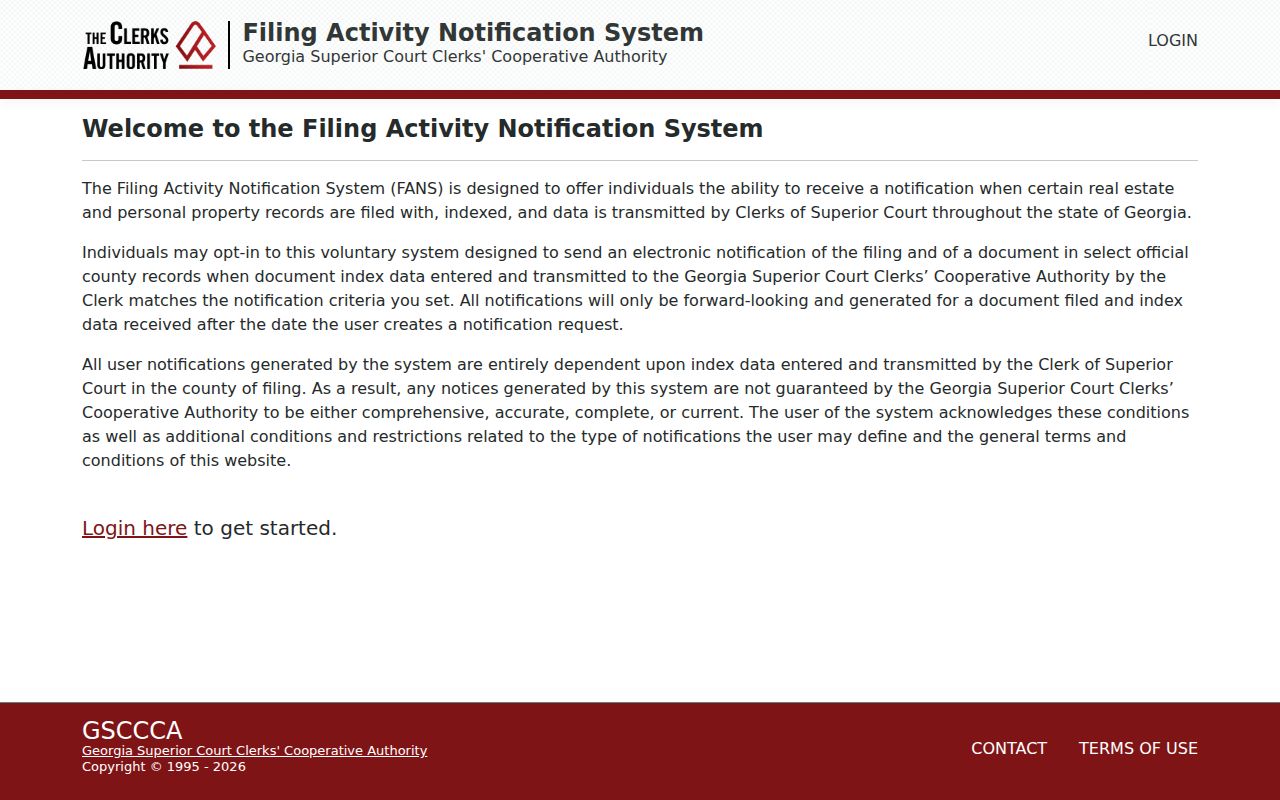
Treat a FANS alert as a nudge to pull the new deed itself, not as proof that the Thomas County chain of title is sound.
Plats Hold the Geographic Thread
The GSCCCA Plat Docket holds subdivision maps, replats, easements, and condominium plans. Plats show lots, blocks, roads, dedications, and dimensions. Rural tracts may use metes and bounds. Match those descriptions across deeds when addresses or parcel numbers change, since GIS is reference data and boundary reliance still requires the recorded plat and a licensed survey.
Thomas County Deeds at the Clerk
The courthouse still matters. Go there when an index entry has no image or when an older deed sits outside the portal's stated coverage. Carry the known names, an approximate recording date, the deed type, and the legal description. Did a newer document cite an older book and page? Copy that citation exactly. The Clerk can tell a deed docket from lien, plat, execution, UCC, or court-file material, which keeps a broad request from skipping the correct record series.
Encumbrance reviews take a second pass. Run every owner-name variant. A materialman's lien or lis pendens may sit outside the deed sequence, while a later cancellation or release must be paired with its original filing. A deed under power of sale can pull security-deed and court or notice research along with it. Probate transfers behave the same way. They may need a will, letters, an order to sell, and an executor or administrator deed rather than one clean buyer-and-seller transaction.
Older Thomas County deed records reward disciplined citation work. FamilySearch splits grantor and grantee alphabets. The indexes sit on separate reels. Once an entry gives a volume and page, move to the matching deed-book reel and record the parties, date, acreage, description, witnesses, and later marginal references. The Georgia Archives notes that county microfilm may be browsable rather than electronically searchable. The clerk vault and Archives county-record microfilm remain the sensible fallback when the filmed run or web portal has a gap.
A directory, obituary, tax roll, or historic-district plaque can name a likely person at an address. That name still proves nothing. Ownership lives in the deed. Tie the name to a deed citation and the same legal description, especially when spelling changed, an estate intervened, a tract was subdivided, or a street was renumbered. Only the citation settles it.
Copying a Thomas County Deed
The online portal covers many deed images. For the rest, contact the Clerk at 325 N. Madison Street in Thomasville, where the office is open weekdays from 8 a.m. to 5 p.m. Mail works too. Send requests to PO Box 1995, Thomasville, GA 31799, and include the names, the year, and either a book-and-page or an instrument number, plus the copy type you want.
The official fee schedule breaks down the charges. Uncertified pages cost $0.50. Assisted copies run $1 per page, and certified copies cost $2.50 for the first page plus $0.50 for each later page. Cards add a convenience fee, and personal checks are not accepted.
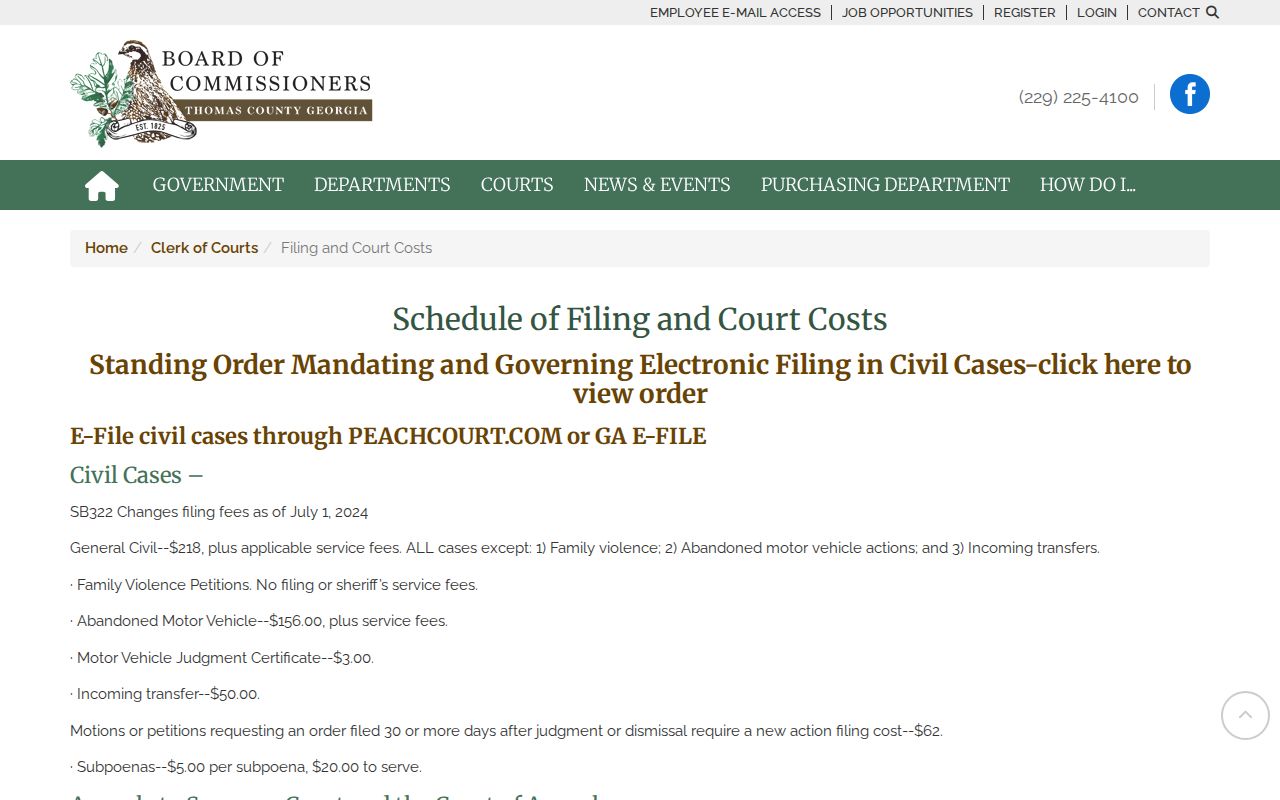
Order certification only when the receiving party requires an authenticated copy.
Recorded, not guaranteed. The index reports filed instruments, not every possible claim. A Georgia attorney or title professional must evaluate clear title.
Georgia's Open Records Act opens another door. It reaches existing nonexempt files that are not conveniently indexed. Describe the party, the parcel, the legal description, the document family, and the date range. Ask for the existing record, not a new report. Agencies generally respond within three business days by producing the files or explaining timing, estimated cost, and any exemption. Search and retrieval time may be billed after the first 15 minutes, and a deed-specific copy fee can override the ordinary copying ceiling.
Some citations point past any online image. The Georgia Archives county microfilm and its Virtual Vault often fill that gap when a clerk or FamilySearch reference runs deeper than the portal. The Thomas University Genealogical Library adds another layer. Its Hopkins Collection, tax rolls, marriage, church, cemetery, and county-history material can untangle a stubborn name clue. Treat all of it as finding aids. A directory listing, an obituary, or a tax entry still has to match the deed's parties and land description before it proves anything about ownership.
A real transaction or dispute deserves a defensible packet. Assemble the newest vesting deed, the relevant prior deed, the recorded plat, open security deeds and liens, releases, probate or court orders, and certified copies requested by the recipient. Compare the parcel number and legal description across sources. Keep the recording date with each reference. The deed index shows the recorded trail. Only counsel can say whether that chain supports the intended legal conclusion.
Note: Keep an index citation so the Clerk can certify an image and distinguish similar parties or repeated transfers.