
Thomas County Property Value Types
Thomas County QPublic publishes the assessment side. Deed records supply the sale side. Georgia assesses property at 40 percent of fair market value, so the assessed figure is never the full market estimate.
| Value | What It Is | Where |
|---|---|---|
| Fair market value | Assessor's full-value estimate | QPublic assessment roll |
| Assessed value | Forty percent of fair market value | QPublic assessment roll |
| Taxable value | Amount after applicable exemptions | Assessment and tax records |
| Last sale price | Consideration tied to a past transfer | Deed trail and possible card history |
A $100,000 market estimate becomes $40,000. The 40 percent rule applies before exemptions, and the tax bill adds millage after that. The deed's sale price stands apart as a separate historic fact.
Look Up Thomas County Values
Start with an address and find the parcel. Then preserve the parcel number and valuation year; Thomas County also advertises owner, legal-information, subdivision, and parcel-number searches.
- Search the location address in QPublic.
- Confirm the parcel number, year, fair market value, assessed value, and exemptions shown.
- Check the recorded deed for sale consideration and transfer date.
- Keep each figure labeled by source and year.
- Assessed value
- The statutory share of fair market value used in taxation.
- Fair market value
- The assessor's estimate of value on the valuation date.
- Reassessment
- A later review that may change the roll's value.
Exact parcel-card labels appear on the live screen. Confirm them there. The Thomas County assessor page supplies the current public entry and valuation notices.
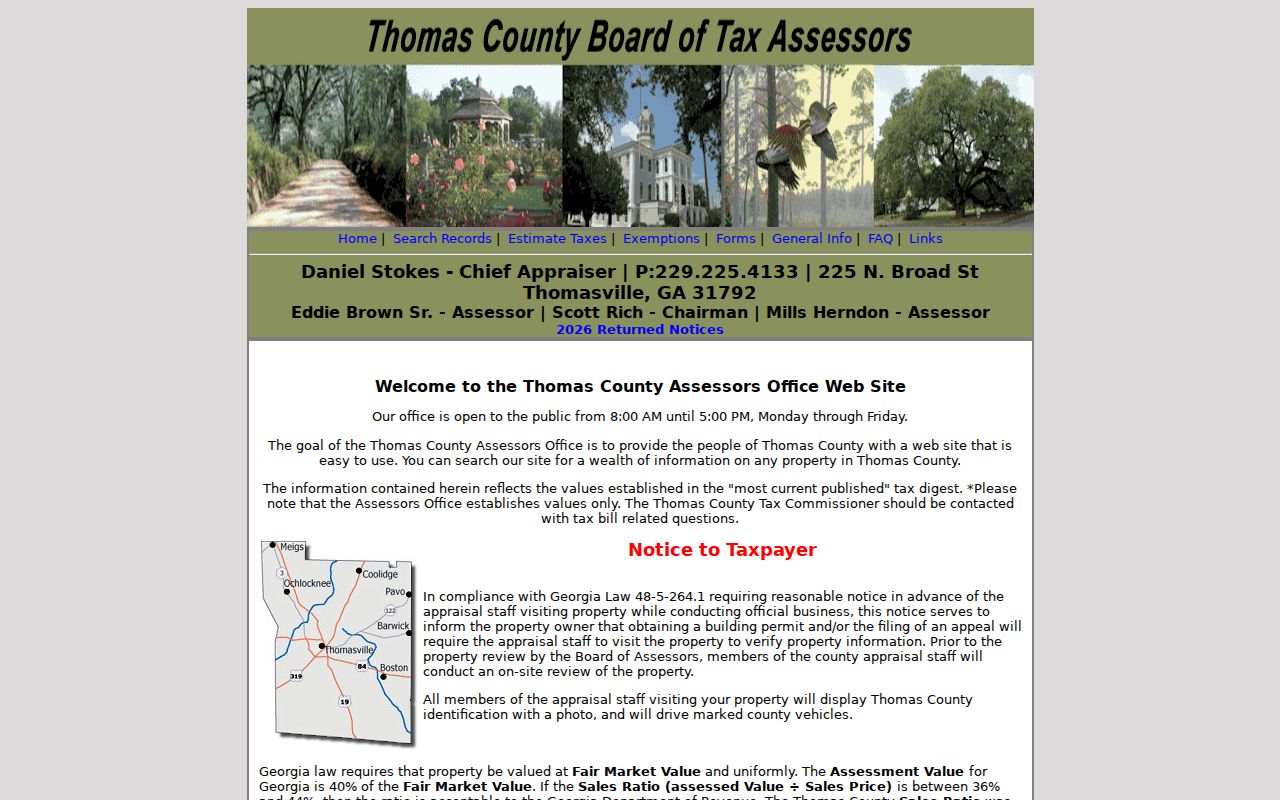
Keep the source date and value year with every figure from that roll.
Date Thomas County Value Evidence
Date everything you save. Record the day a portal was opened and the year attached to every value. A later screen may show a new digest, a correction, an exemption, a construction review, or a parcel change. A bare dollar amount explains nothing. For long-term research, keep the parcel ID and a legal clue beside each year's figures, since addresses and parcel shapes can shift over time. That discipline keeps you on the same land.
Document a Thomas County Value
A good value record holds more than a number. Save the parcel number, situs, legal clue, tax year, fair market value, assessed value, taxable value, and any exemption note. Sales need more. Add the deed and recording dates, instrument type, parties, consideration, and whether one deed covers several parcels.
Label the source beside each figure. QPublic reflects the published digest. The Tax Commissioner holds the bill and payment status, while GSCCCA and the clerk hold the instrument. Unlabeled figures from those systems can turn valid facts into a false comparison.
Unclear fields deserve a phone call. The Assessor sits at 225 North Broad Street in Thomasville, or at 229-225-4133. Ask what a figure represents and which year it covers; staff explain the roll, but a sale, loan, estate, or lawsuit calls for a private appraiser.
Compare Thomas County Value Records
Compare like with like. Group fair market estimates from the same year, or recorded sales with similar dates and terms. One parcel's assessed value is not another parcel's sale price. Georgia's 40 percent ratio makes that mismatch a large error.
Parcel identity matters too. A single deed can convey several tracts for one price, while QPublic values each current parcel. A split can distort an old price. Read the legal description and plat before treating consideration as a value clue.
Exemptions explain another gap. They cut taxable value without touching the fair market estimate. Conservation use and forest-land programs follow preferential rules. A low taxable figure does not prove the land would sell for that sum, so keep market, assessed, and taxable columns separate.
The roll can move without a sale. New construction, demolition, corrected acreage, inventory review, or a use change can shift an assessment, and Thomas County's duties include inventory, sales analysis, new-construction collection, and tax mapping. Check the year and description before blaming the market.
Thomas County Valuation Year
Georgia works on a January 1 market basis. A value must be read with its tax year, then, not as a live quote on the day someone opens the portal. Thomas County's 2025 adjustments rested on 2024 sales, by the county's own notice, and a later deed can record a new price without instantly changing the published assessment.
Record the tax year too. Save the market figure, assessed figure, exemption status, and sale date. Screens disagree sometimes. First test whether they describe different years or different value types. That check resolves many apparent errors.
Thomas County Land and Improvements
Assessment work covers the real-property inventory, sales analysis, verification, new construction, and tax mapping. A parcel card may split land from building improvements. The Schneider portal is gated, though. Verify the current field labels there rather than trusting secondhand descriptions.
Land and improvement figures are model components. They are not separate sale prices. Demolition, construction, parcel splits, use changes, or corrected characteristics can move a later roll without any open-market sale.
Thomas County Recorded Sale Price
A recorded deed in Thomas County can carry a price that misleads. Quitclaims, gifts, estate transfers, and multi-parcel sales often show consideration far from market value. The same goes for partial-interest deeds. Match the legal description before weighing a sale figure against QPublic. That way the parcel lines up.
The last sale price also looks backward. It proves a transaction happened. The assessor's fair market value, by contrast, is an administrative estimate pinned to a stated year. Neither number predicts what a parcel would fetch today. Several verified arm's-length sales give better context. That beats a single transfer pulled from the property records.
Value Stops Before Thomas County Tax
Millage turns assessed value into one input of a tax bill. City and county levies and exemptions then reshape the total. Those steps sit with the Tax Commissioner. Read the value record first on its own terms.
Thomas County's standard tax page lists November 15 as the due date. A 2025 resolution set a different date for that year. Always check the current bill before paying. The due-date wrinkle changes nothing about value. Fair market value and assessed value still mean the same thing in the property records.
Thomas County Sales Ratio Checks
Georgia assesses at 40 percent. Thomas County's assessor reports annual sales-ratio confirmation from 2019 through 2024 landing between 36 and 44 percent. That is a countywide quality check on the mass appraisal. It guarantees nothing for a single home.
The county also noted that 2025 adjustments drew on 2024 sales. So match the roll year to the deed date first. Only then explain any gap between assessed value and a recorded price.
Thomas County Taxable Value
Homestead, senior, veteran, surviving-spouse, conservation-use, and forest-land programs can all shift taxable treatment. An exemption does not automatically lower the assessor's fair market estimate, though. CUVA and forest-land parcels follow current-use rules instead. They skip open-market comparison.
The Board of Assessors handles values and exemptions. The Tax Commissioner issues the bill. For bill math and appeals, see Thomas County property tax records.
Limits of Thomas County Assessed Value
The assessor's number feeds a mass appraisal for taxation. It is not a private appraisal for a sale, loan, estate, or court case. Deed consideration can likewise stem from a family transfer, gift, or partial interest, which makes it a weak market comparison in the deed records.
Value versus price. Thomas County assessed value is for taxation. It is not a sale forecast or licensed appraisal.
Bring in a licensed appraiser when current market value must support a deal or legal decision. Hire a surveyor, not a value record, when acreage or boundary lines are in dispute.
Keep the value source, year, parcel number, and record date together whenever figures get saved, compared, or shared.
Any Thomas County value comparison should end plainly. State what each figure supports. The fair market estimate gives the assessor's full-value view for its year. Assessed value applies Georgia's statutory level. Taxable value reflects eligible adjustments. Recorded consideration describes a past deed with its own terms. None of them alone proves an asking price, replacement cost, loan value, or appraisal conclusion, so keep the labels intact and call the right professional when the question outgrows public property records.